Introduction
Software testing has improved significantly over time.
In the past, testing was mostly done manually. Testers had to go through application screens, enter data, check results, and repeat the same steps many times. Later, automation tools were introduced, which made testing faster and more efficient. Now, Artificial Intelligence (AI) is taking testing to the next level.
One of the latest developments in this area is Agentic Test Automation.
In Tricentis Tosca, agentic test automation does more than just execute tests automatically. It helps teams create test cases faster, adapt to changes in the application, identify and analyze errors, and improve testing over time. This makes the overall testing process more efficient and reliable.
What is Test Automation?
Test automation is the process of using software tools to execute test cases automatically, instead of performing them manually.
Example:
Instead of a tester repeatedly clicking buttons and verifying results, an automation tool performs these actions efficiently and consistently.
What is Tosca?
Tricentis Tosca is a no-code/low-code automation tool used for software testing.
It is based on Model-Based Testing (MBT), where tests are created using reusable models instead of traditional scripts. This approach supports Agentic AI by making it easier for the system to understand, modify, and optimize test cases.
As a result, users do not need strong programming knowledge, test cases can be created using simple steps, and test components are reusable and easier to maintain
What Is Agentic Test Automation?
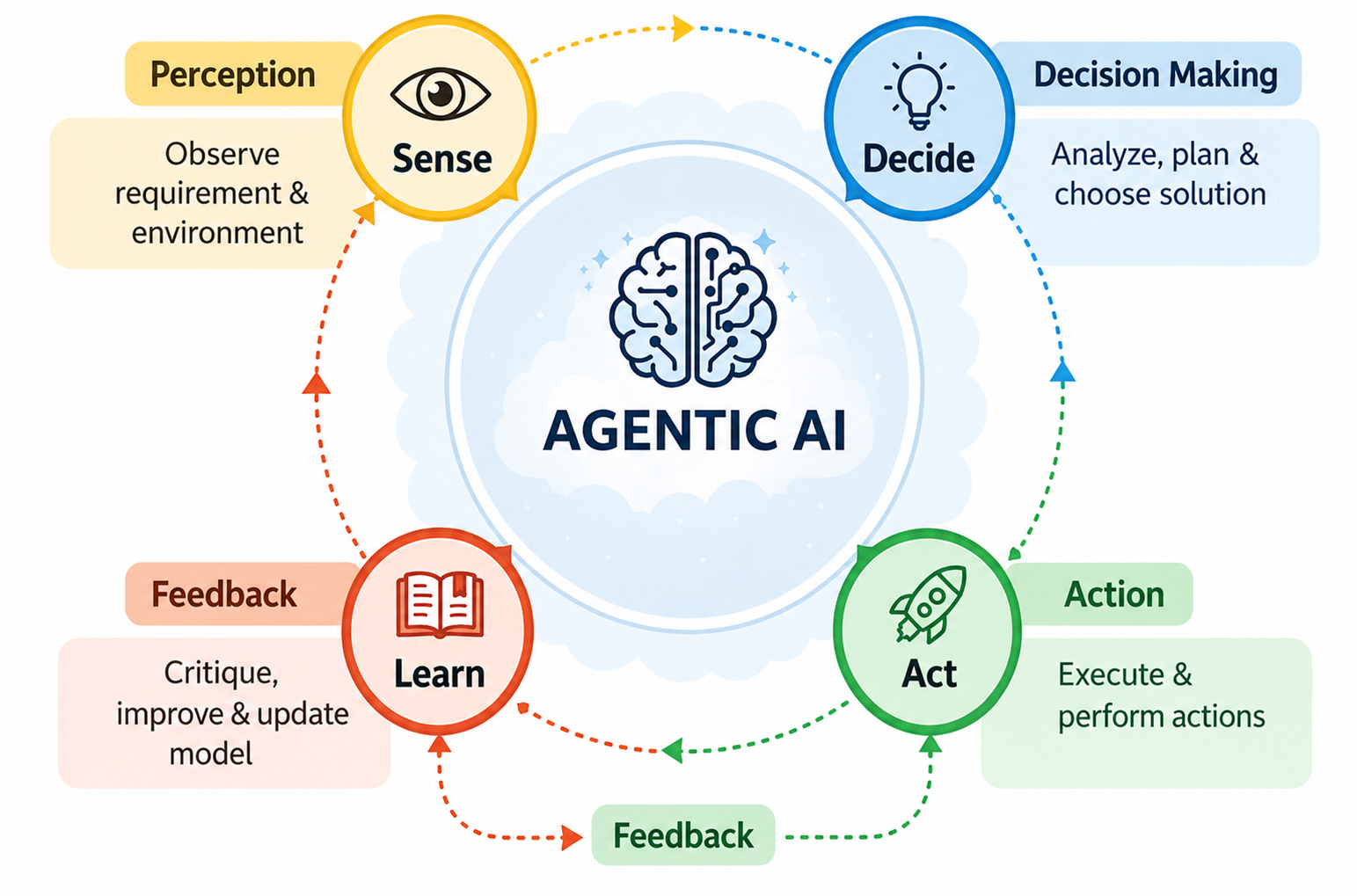
Think of Agentic AI as a smart helper for testing.
Instead of just following fixed steps, it can understand what needs to be tested, decide what to do next, perform actions, and learn from past results. In simple words, it can think, decide, and act with less human effort compared to traditional automation.
This does not mean testers are not needed. It simply means testers get support from a smarter system that reduces repeated work and helps teams work faster
Why This Matters in Real Projects
In real-world software projects, testing is often complex and challenging.
Applications change frequently. A button may move, a field name may change, or a new screen may be added. Sometimes, a workflow that worked earlier may behave differently after an update. Traditional automation struggles in such situations because it relies heavily on fixed scripts and stable user interfaces.
This is where agentic automation becomes important. Unlike traditional automation, which is more rigid, agentic automation can generate test cases using AI, adapt during execution, support self-healing, and provide better insights into failures.
In addition, it helps teams handle frequent releases in Agile and DevOps environments, where continuous testing is required. It also reduces the effort needed to maintain test scripts when applications change.
For businesses, this means spending less time fixing broken tests, reducing manual effort, improving test coverage, and focusing more on delivering high-quality software.
Where Tosca Fits In
Tricentis Tosca plays an important role in enabling agentic test automation.
It is a no-code/low-code automation tool built on Model-Based Testing (MBT). Instead of creating complex scripts for every test case, testers can use reusable models and modules. This makes test creation simpler and easier to maintain.
This structured and reusable approach provides a strong foundation for Agentic AI. Since the test components are organized and easy to understand, the AI system can work more effectively to generate, modify, and optimize test cases.
As a result, Tosca not only simplifies automation but also supports intelligent testing by allowing AI to adapt, improve, and manage tests more efficiently.
Difference Between Traditional Automation and Agentic AI Automation
| Traditional Automation (Without Agentic AI) | Agentic AI Automation (In Tosca) |
| Test cases are created manually by testers | Test cases are automatically generated using AI |
| Follows fixed scripts | Can adapt and make decisions dynamically |
| Breaks when UI changes | Self-healing adjusts to UI changes |
| High maintenance effort | Low maintenance due to AI |
| Execution is predefined | AI optimizes execution flow |
| Limited intelligence | Smart and intelligent system |
| Requires human intervention for failures | AI analyzes and explains failures |
| Slower execution | Faster and efficient execution |
| No learning capability | Learns and improves over time |
| Rule-based approach | AI and data-driven approach |
Architecture of Agentic AI in Tosca
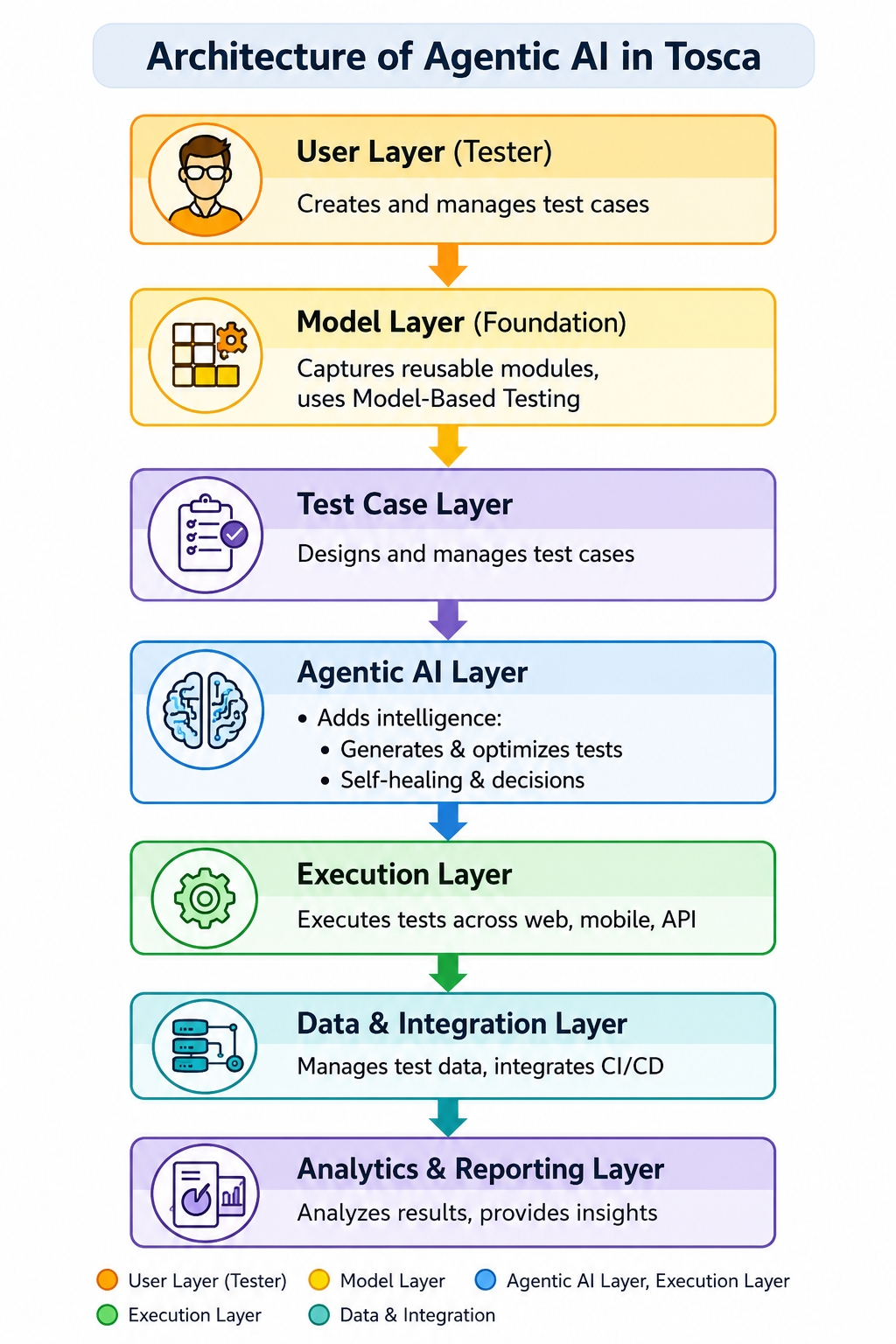
The architecture of Agentic AI in Tricentis Tosca explains how different components work together to perform intelligent and automated testing. It is designed in multiple layers, where each layer has a specific role in the testing process.
At the top is the User Layer, where testers interact with the system using Tosca Commander. In this layer, users create and manage test cases without needing programming knowledge.
Next is the Model Layer, which is the foundation of Tosca. Here, application elements are captured as reusable modules. This is based on Model-Based Testing, which allows easy maintenance and reusability of test components.
The Test Case Layer uses these models to design test cases. Testers combine different modules to create complete test scenarios in a simple and structured way.
The Agentic AI Layer acts as the brain of the system. It adds intelligence by automatically generating test cases, making decisions during execution, performing self-healing when changes occur, and optimizing tests for better performance.
Below this is the Execution Layer, where all test cases are executed automatically across different platforms such as web, mobile, and APIs.
The Data and Integration Layer handles test data and integrates with CI/CD tools like Jenkins and Azure DevOps. This enables continuous testing in DevOps environments.
Finally, the Analytics and Reporting Layer provides test results and insights. It analyzes failures, identifies root causes, and helps improve future test executions.
Overall, this layered architecture makes Agentic AI in Tosca a powerful and efficient solution for modern software testing. It combines Model-Based Testing with AI capabilities to deliver faster, smarter, and more reliable testing.
How Agentic Automation Works in Tricentis Tosca
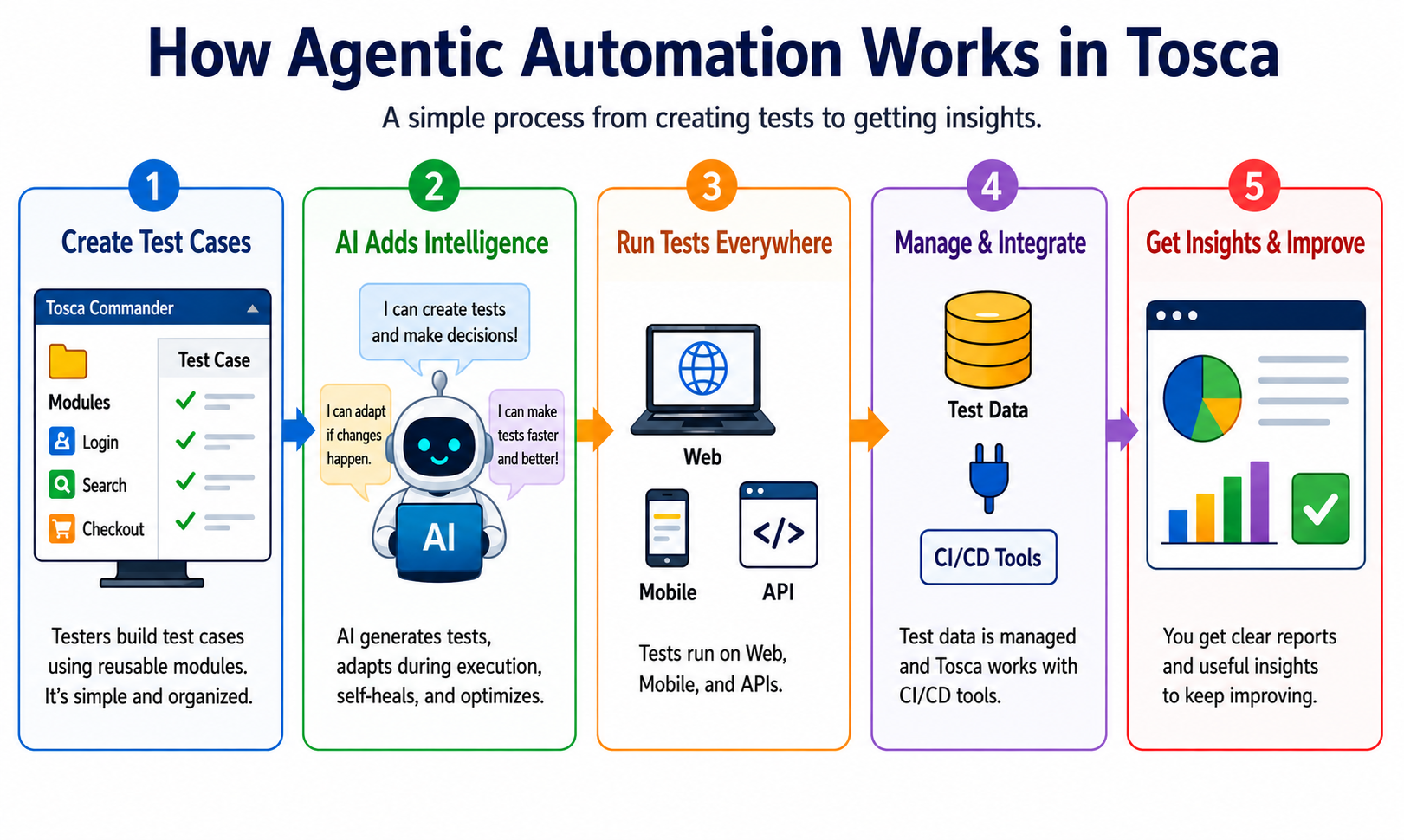
Agentic automation in Tricentis Tosca works as a structured and intelligent process that supports the complete testing lifecycle. Testers start by creating and managing test cases in Tosca Commander. The system uses reusable modules as part of the Model-Based Testing (MBT) approach, which act as the building blocks for test scenarios. These modules are combined to design complete test cases in a simple and organized way.
On top of this, the Agentic AI layer adds intelligence to the process. It can automatically generate test cases, make decisions during execution, adapt to changes using self-healing, and optimize test execution for better performance.
The tests are then executed across multiple platforms such as web, mobile, and APIs. Along with execution, the system also manages test data, integrates with CI/CD tools, and provides detailed analysis and reporting.
Overall, this approach ensures that testing is not only automated, but also adaptive, efficient, and continuously improving over time
A Simple Way to Understand the Flow
Agentic test automation follows a continuous lifecycle instead of a one-time process.
The workflow includes understanding requirements, creating models, designing test cases, preparing data, executing tests, adapting to changes, analyzing results, and improving for the next run. This process works as a continuous loop, allowing the system to learn and improve over time.It can adjust to changes using self-healing, optimize test execution, and provide better results based on past executions. Overall, this makes agentic automation more intelligent than traditional automation, as it not only executes tests but also adapts and improves continuously.
Core Capabilities of Agentic AI in Tricentis Tosca
Agentic AI provides several powerful features that make software testing faster, smarter, and more efficient:
- Automatic Test Case Generation
It automatically generates test cases based on given requirements.
Using Tosca Copilot (Generate a TestCase), users can quickly create test cases. - TQL Query Generation
It helps create queries to search and manage test objects easily.
With Create a TQL search query, users can write queries using simple language instead of complex syntax. - Test Case Summary
It provides a quick summary of test cases.
Using Get a Test Case summary, users can understand test steps easily. - Test Execution Insights
It gives insights about test execution results.
With Get Test Execution insights, users can quickly analyze test outcomes. - Ask Tosca (AI Assistant)
It allows users to ask questions and get instant help.
Using Ask a question about Tosca, users can get guidance without manual searching. - Self-Healing Automation
It adapts to application changes (such as UI updates) and updates tests automatically.
With Vision AI scanning, Tosca identifies elements visually, so tests do not break when UI changes. - Intelligent Test Execution
It selects and executes the most relevant tests efficiently.
Agentic AI decides which tests to run based on priority and past results. - Failure Analysis
It detects failures and clearly explains the root cause.
AI and Copilot help in understanding failures quickly. - Test Data Management
It creates and manages the data required for testing.
- Cross-Platform Testing
It supports testing across web, mobile, and API applications.
Vision AI works across different platforms using visual recognition. - CI/CD Integration (Continuous Testing)
It integrates with tools like Jenkins and Azure DevOps to enable automated testing in pipelines. - Learning and Improvement
It learns from previous test executions and continuously improves performance.
These features help reduce manual effort, increase accuracy, and accelerate the overall testing process.
When to Use Agentic AI in Tosca
Agentic AI is most useful in situations where testing needs to be fast, efficient, and adaptable:
- Large Projects
When there are many test cases to manage and execute. - Frequent Application Changes
When the application UI or functionality changes often. - Repetitive Testing (Regression Testing)
When the same tests need to be run multiple times. - Agile and DevOps Environments
When quick testing is required for continuous integration and delivery. - Limited Time for Testing
When faster test creation and execution are needed. - Complex Applications
When testing involves multiple platforms like web, mobile, and APIs.
Benefits of Agentic AI
Agentic AI provides several benefits that improve the overall testing process:
- Saves Time
Automates test creation and execution, reducing manual effort. - Reduces Human Errors
Minimizes mistakes that can happen during manual testing. - Faster Test Execution
Runs tests quickly, helping in faster software releases. - Low Maintenance
Self-healing capability reduces the need for frequent updates. - Improved Accuracy
Provides more reliable and consistent test results. - Better Test Coverage
Can generate and execute more test scenarios, including edge cases. - Supports Continuous Testing
Easily integrates with CI/CD pipelines for regular testing. - Handles Complex Applications
Works across web, mobile, and API testing.
Challenges of Agentic AI
While Agentic AI offers many advantages, it also comes with some challenges:
- Initial Setup Effort
Setting up AI-based testing tools can take time and planning. - Learning Curve
Testers need to understand how the AI system works to use it effectively. - Dependency on AI Accuracy
Results depend on how well the AI understands requirements and data. - Cost
Advanced AI tools and infrastructure can be expensive. - Debugging Complexity
It can sometimes be difficult to understand how the AI made certain decisions. - Data Dependency
Requires good quality data for accurate results. - Not Fully Replaceable
Human testers are still needed for critical thinking and decision-making.
Real-World Example 1: Login Testing
Let’s take a simple example.
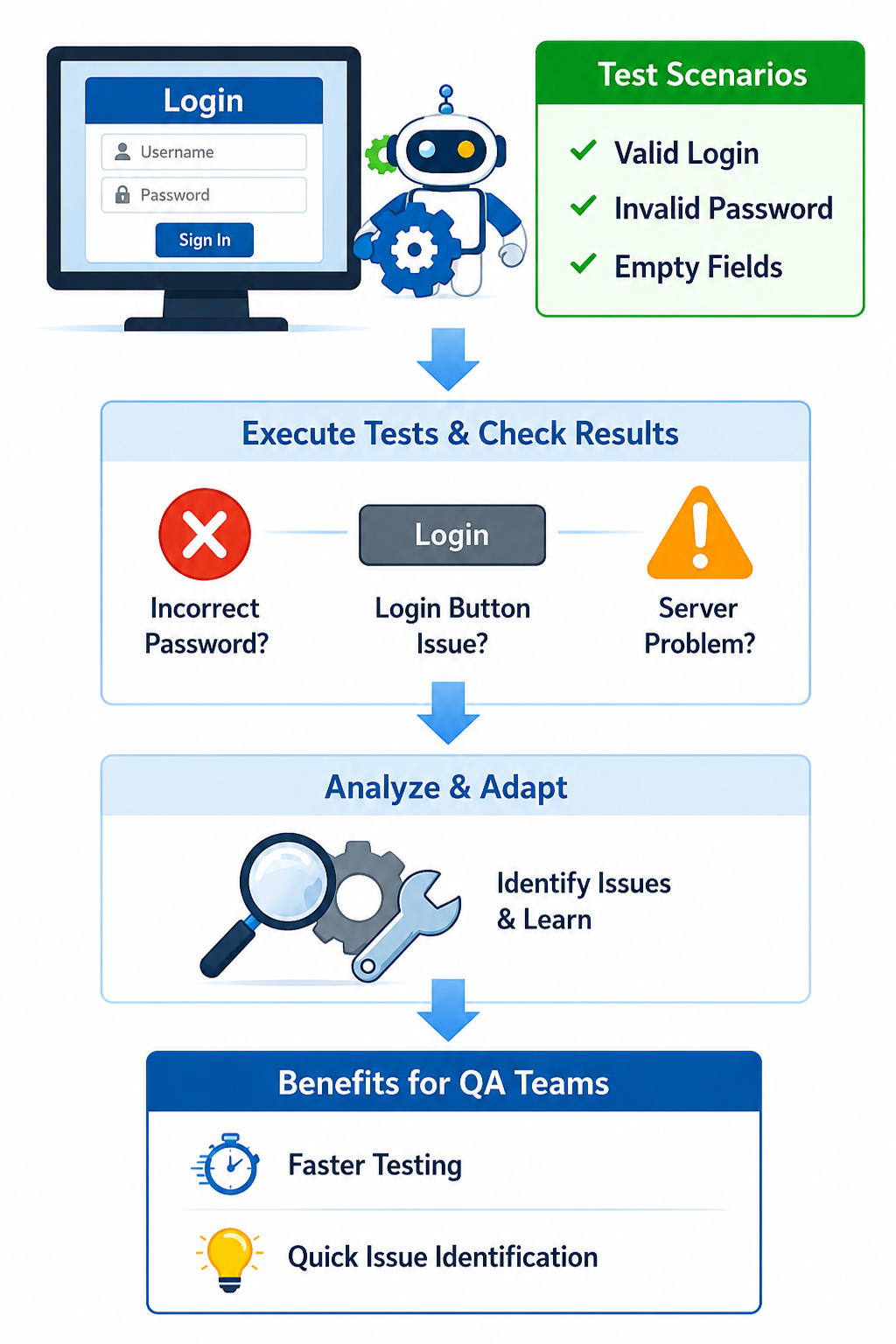
A company needs to test a login page where users should be able to sign in with a valid username and password.
Using agentic automation, the system creates test scenarios such as:
- Valid login
- Invalid password
- Empty input fields
It then executes these tests and verifies the results. If a test fails, it identifies the issue, such as:
- Incorrect credentials
- Login button not working
- Server issue
The system can also handle minor changes and improve future test runs based on past results.
For a QA team, this leads to faster testing and easier identification of issues.
Real-World Example 2: E-commerce Checkout
Now consider an e-commerce application.
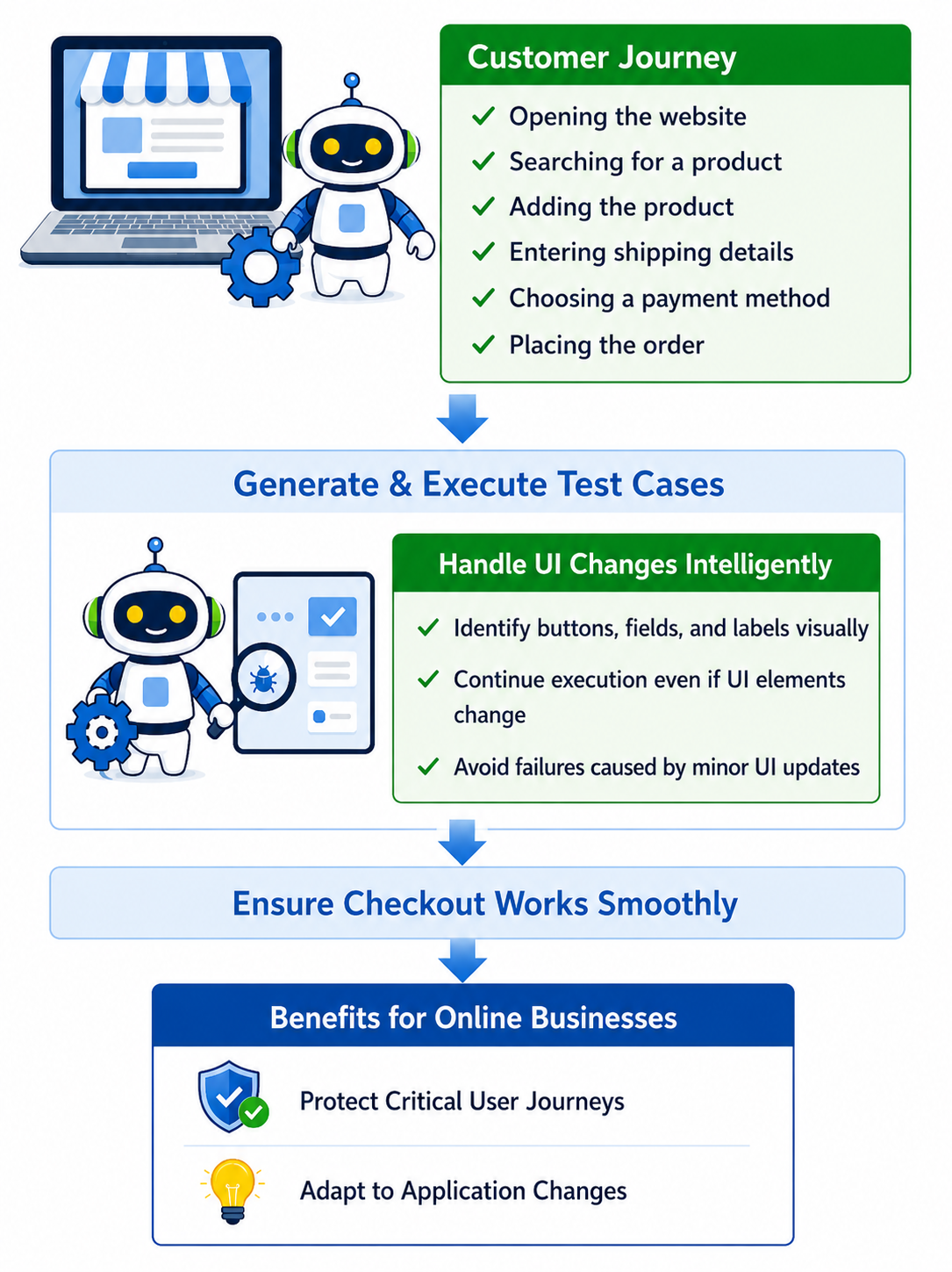
A typical customer journey includes:
- Opening the website
- Searching for a product
- Adding the product to the cart
- Entering shipping details
- Choosing a payment method
- Placing the order
This process is very important for the business, but it is also sensitive to changes. Even a small update in the cart or payment page can break traditional test scripts.
With agentic automation, the system can generate and execute test cases for this flow. It can also handle UI changes using self-healing and screen understanding.
For example, the system can:
- Identify buttons, fields, and labels visually
- Continue execution even if UI elements change
- Avoid failures caused by minor UI updates
For online businesses, this ensures that critical user journeys like checkout continue to work smoothly, even as the application changes.
Real-World Example 3: Banking or Financial Applications
Now consider a banking or financial application.
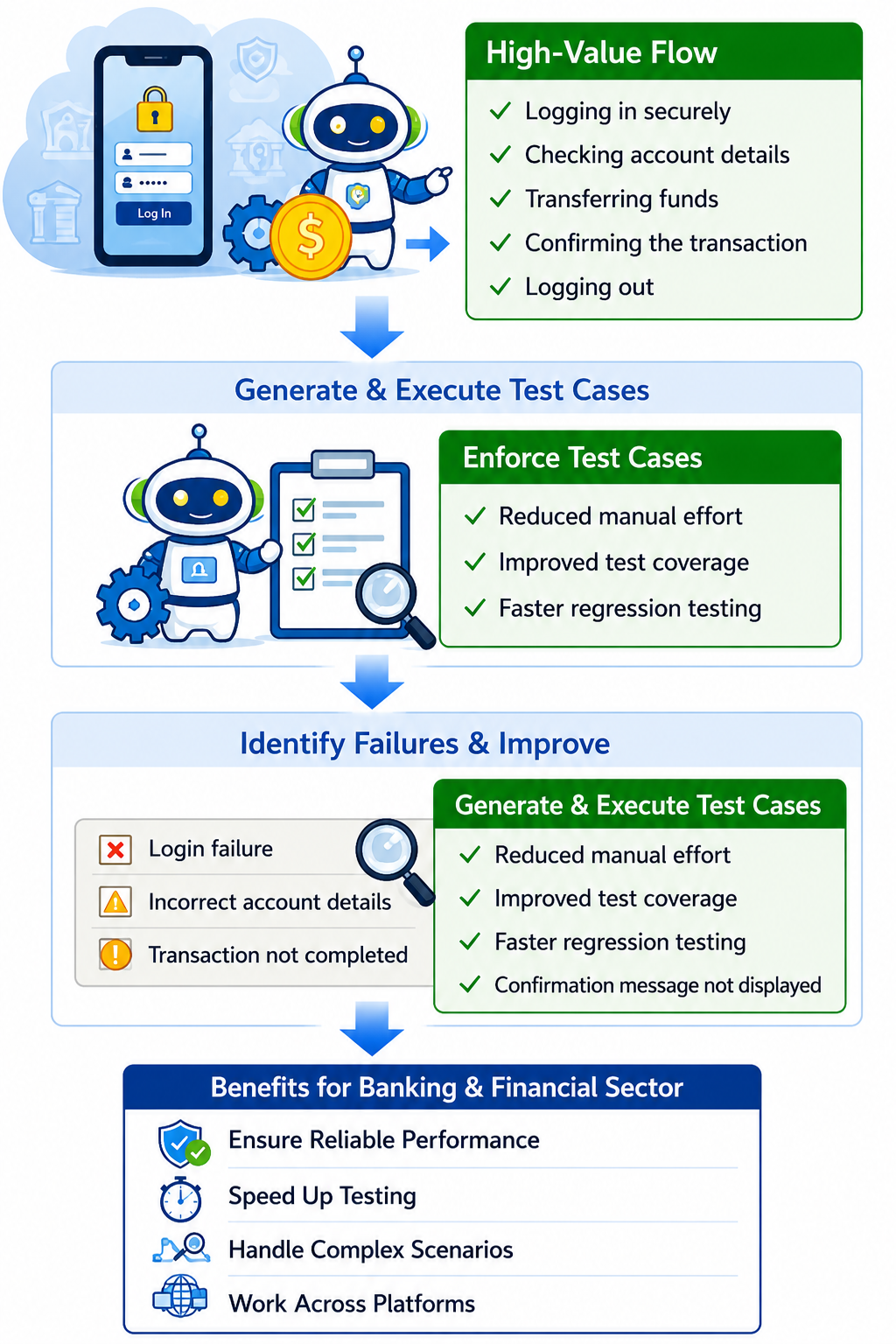
A typical high-value flow includes:
- Logging in securely
- Checking account details
- Transferring funds
- Confirming the transaction
- Logging out
These workflows are very sensitive. Even a small issue can lead to customer frustration or business risk.
With agentic automation, the system can generate and execute test cases for these critical flows. It helps ensure that all steps work correctly and consistently.
If any issue occurs, the system can identify the reason, such as:
- Login failure
- Incorrect account details
- Transaction not completed
- Confirmation message not displayed
It also reduces manual effort, improves test coverage, and speeds up repeated testing. The system can work across different platforms and handle complex scenarios more effectively.
For organizations in banking and financial sectors, this ensures reliable performance, faster testing, and better overall quality.
Real-World Example 4: Fast-Changing Enterprise Applications
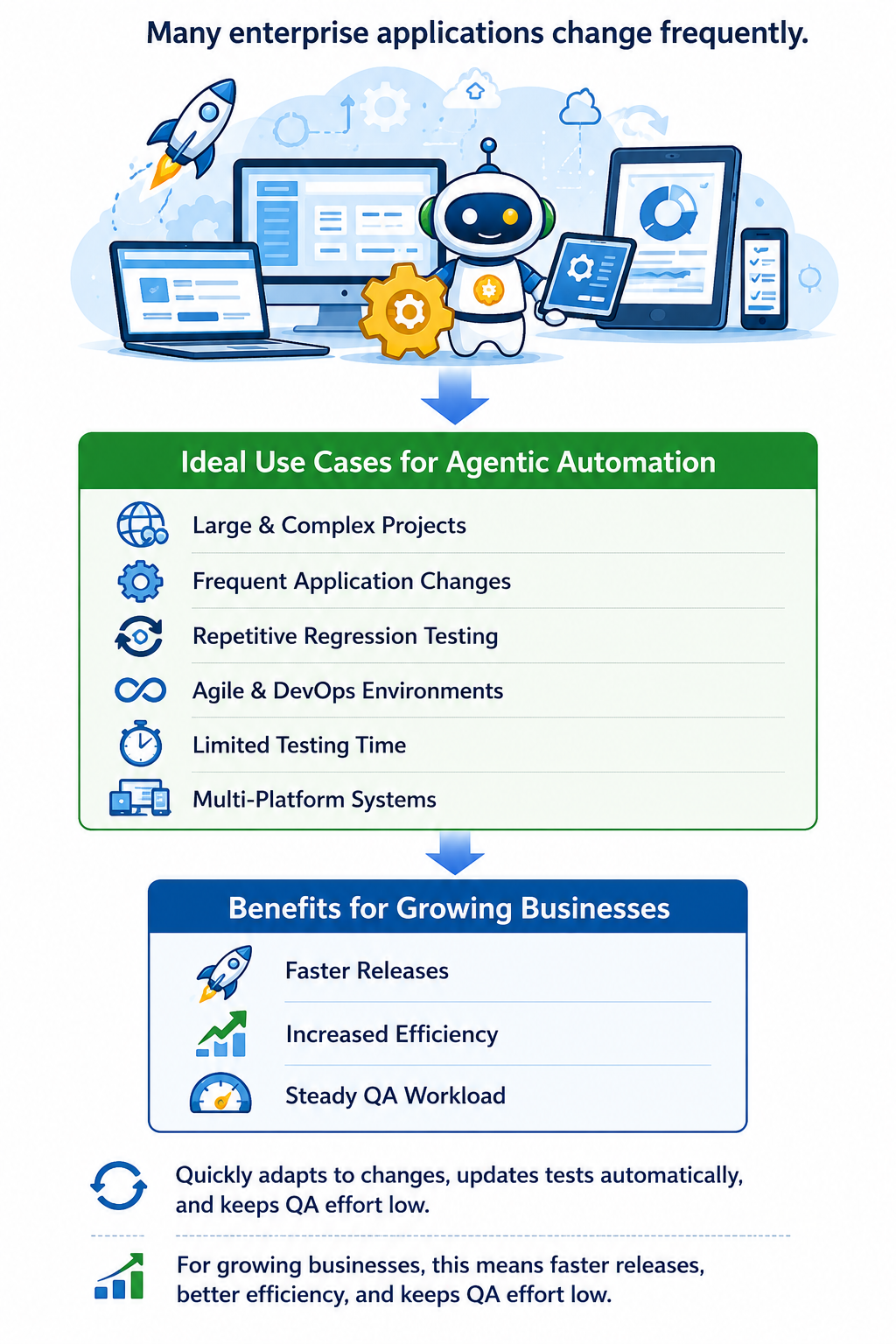
Many enterprise applications change frequently.
Teams often work in Agile sprints, release updates regularly, and test across different platforms such as web, mobile, and APIs.
Agentic automation is especially useful in these situations. It supports testing in environments that involve:
- Large and complex projects
- Frequent application changes
- Repetitive regression testing
- Agile and DevOps workflows
- Limited testing time
- Multi-platform systems
With agentic automation, the system can quickly adapt to changes, update test cases automatically, and continue execution without major interruptions.
This reduces the effort required to maintain test scripts and ensures that testing keeps up with fast development cycles.
For growing businesses, this means faster releases, better efficiency, and no increase in QA workload.
Key Benefits for Businesses
For potential customers reading a Radixlink blog, the key question is simple:
What business value does this bring?
Agentic automation provides strong business value by improving efficiency, reducing effort, and supporting faster software delivery.
It helps organizations:
- Save time by automating test creation and execution
- Reduce manual effort and minimize human errors
- Speed up test execution and release cycles
- Lower maintenance through self-healing capabilities
- Improve accuracy and reliability of test results
- Increase test coverage, including edge cases
- Support continuous testing in CI/CD pipelines
In addition, it allows teams to focus more on quality and innovation instead of spending time fixing and maintaining test scripts.
This is important because most teams are not just looking for more automation—they need solutions that are scalable, reliable, and easy to maintain over time.
But It Is Not Magic
Agentic automation is powerful, but it is not a complete replacement for human testers. Setting it up requires effort, and teams need time to learn and use the tools effectively. Its performance also depends on good data, proper configuration, and well-defined test cases.
In addition, human involvement is still important for decision-making, understanding complex scenarios, and ensuring overall quality.
However, this is not a weakness. The real value of Agentic AI lies in supporting testers, not replacing them. By handling repetitive and time-consuming tasks, it allows teams to focus on more important work.
When used effectively, it helps teams work faster, smarter, and more efficiently.
Final Thoughts
Agentic Test Automation in Tricentis Tosca is not just another testing trend. It represents a practical shift toward smarter and more efficient automation.
By combining model-based testing with AI-driven capabilities such as automated test creation, visual execution support, self-healing, failure analysis, and continuous improvement, Tosca enables teams to move beyond rigid automation and adopt a more flexible and adaptive approach.
For businesses, the value is clear: faster testing cycles, reduced maintenance effort, better adaptability to changes, and increased confidence in software quality.
For teams working in fast-paced development environments, this approach helps keep up with frequent releases while maintaining reliability and efficiency.
Overall, agentic automation supports a more modern and scalable testing strategy, helping organizations deliver high-quality software with greater speed and confidence.
CTA
Want our Tosca starter kit & module checklist? Contact Radixlink and ask for the “Tosca Module Checklist.”
Hashtags
#AgenticAI #AgenticTestAutomation #TricentisTosca #Tosca #SoftwareTesting #TestAutomation #AITesting #IntelligentAutomation #ModelBasedTesting #MBT #QualityAssurance #QA #ContinuousTesting #CICD #DevOps #RegressionTesting #SelfHealingAutomation #VisionAI #DigitalTransformation #Radixlink