Introduction
Every modern enterprise application is held together by APIs. When a sales rep closes a deal in Salesforce, an API carries that data to SAP for order processing. When a patient checks in at a hospital, APIs synchronize records across scheduling, billing, and clinical systems in real time. When a payment clears on an e-commerce platform, a chain of API calls handles authentication, inventory, fulfillment, and notification simultaneously.
APIs are the connective tissue of enterprise software. When they fail, business processes stop often silently, and often in production.
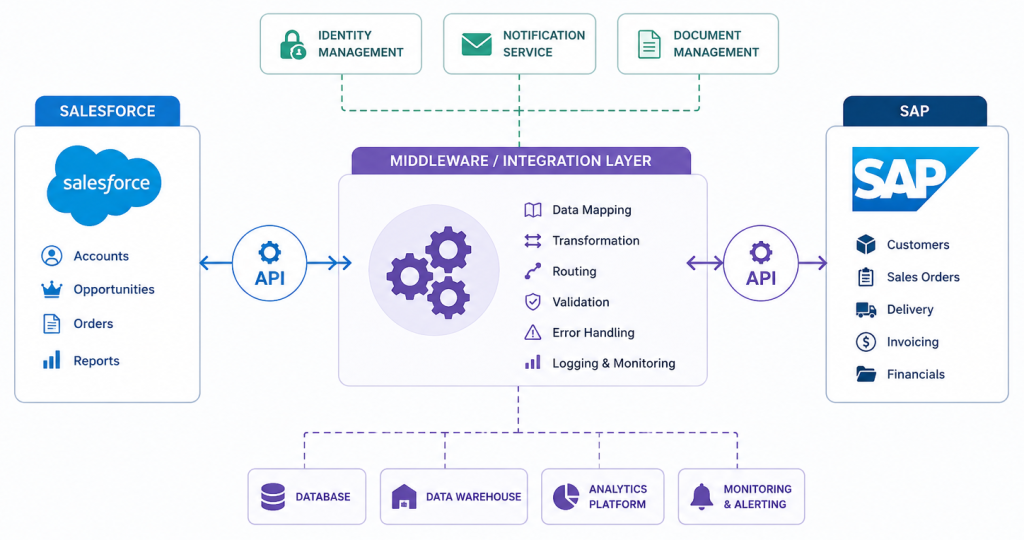
This guide covers how Tricentis Tosca approaches API testing at enterprise scale: what the tooling actually does, how it handles real integration scenarios, and what teams need to know to build a testing framework that holds up under pressure.
Why UI Testing Alone Is Not Enough
User interface testing validates what users see. It confirms that a button works, a form submits, or a page renders correctly. What it cannot confirm is whether the backend processed the request correctly, whether the right data was written to the database, or whether a downstream system received and acted on the payload.
In a microservices architecture, a single user action can trigger fifteen or more API calls across independent services. A UI test that passes gives no visibility into whether those calls succeeded, whether the data was transformed correctly, or whether error handling is in place when something goes wrong.
This is why teams that test only at the UI layer routinely encounter production defects that were present in the backend long before the release. API testing shifts that discovery earlier, at the point where the logic actually lives.
What Tosca Brings to API Testing
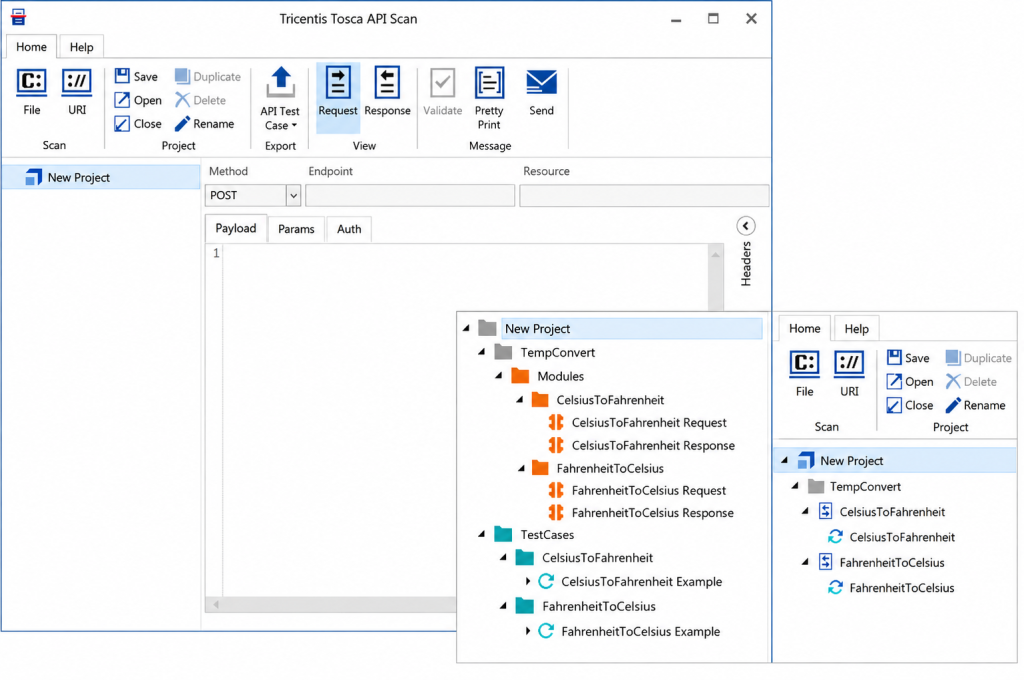
Tricentis Tosca takes a model-based approach to API test automation. Rather than writing and maintaining test scripts, teams scan an API definition once and Tosca generates a reusable module that stores the endpoint structure, request schema, headers, and response format.
This matters in practice because enterprise APIs change frequently. In a traditional scripting framework, a change to a single endpoint might require updates across dozens of test scripts. In Tosca, the module is updated once and every test case that references it is automatically aligned.
The two core components that make this work are:
API Scan reads service definitions from Swagger, OpenAPI, WSDL, and OData sources and generates the test modules automatically. This removes the need to manually configure request structures.
API Engine handles execution: sending requests, receiving responses, processing payloads, validating results, and managing runtime behavior across protocols. The separation of design and execution means teams can build test cases independently of when or where they run.
Supported Protocols
Tosca supports REST, SOAP, OData, and GraphQL within a single framework. This matters in hybrid enterprise environments where modern cloud services sit alongside legacy SOAP-based systems. A test suite can cover a REST API from a cloud platform and a SOAP service from an on-premise ERP in the same workspace without switching tools.
Example: Salesforce and SAP Order Integration
One of the most common enterprise integration patterns involves Salesforce as the CRM and SAP as the ERP. The scenario works like this: a sales representative closes an opportunity in Salesforce, which triggers a series of API calls that create a customer record, generate a sales order, check inventory, and initiate fulfillment in SAP. The entire workflow depends on multiple APIs passing data correctly at each handoff.
Testing this manually is slow and unreliable. Testing only the Salesforce UI tells you nothing about whether SAP received and processed the payload correctly.
In Tosca, this workflow is tested using API chaining, each API call in the sequence is configured as a separate module, and the output of one call is passed as the input to the next using dynamic buffering.
A practical example of how the chain looks:
- POST /oauth/token : Authenticate against Salesforce and capture the access token into a buffer: {B[SFAccessToken]}
- POST /sobjects/Opportunity : Create the opportunity in Salesforce, capture the returned Opportunity ID: {B[OpportunityID]}
- POST /sobjects/Order : Create the linked order using {B[OpportunityID]}, capture the Order Number: {B[SFOrderNumber]}
- POST /sap/sap/API-SALES-ORDER : Create the corresponding sales order in SAP using the mapped order data, validate the SAP Order ID in the response
- GET /sap/opu/odata/sap/API-DELIVERY : Check that a delivery document was generated in SAP for the order
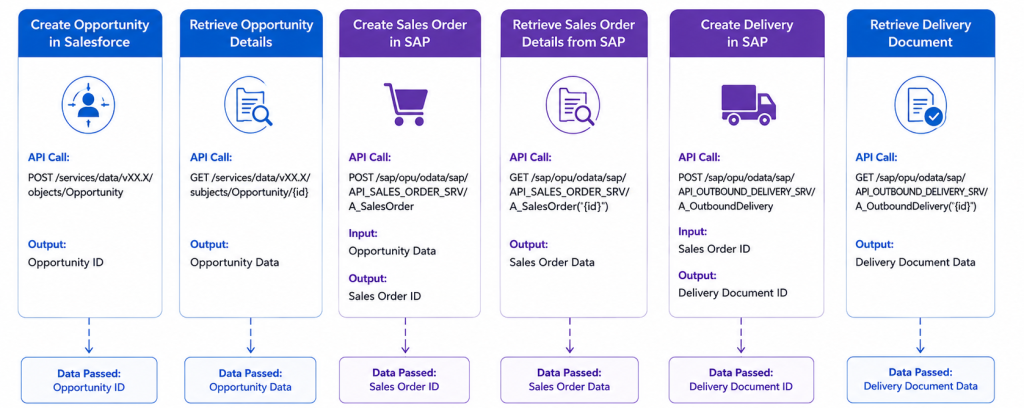
Each step validates not just that a 200 status was returned, but that the correct data was written, the IDs match across systems, and the business workflow advanced as expected.
Dynamic Data Handling
Static test data breaks in real enterprise environments. Access tokens expire. Session IDs change per request. Transaction references are generated at runtime. A test that hardcodes these values will fail the moment a token rotates or an environment is refreshed.
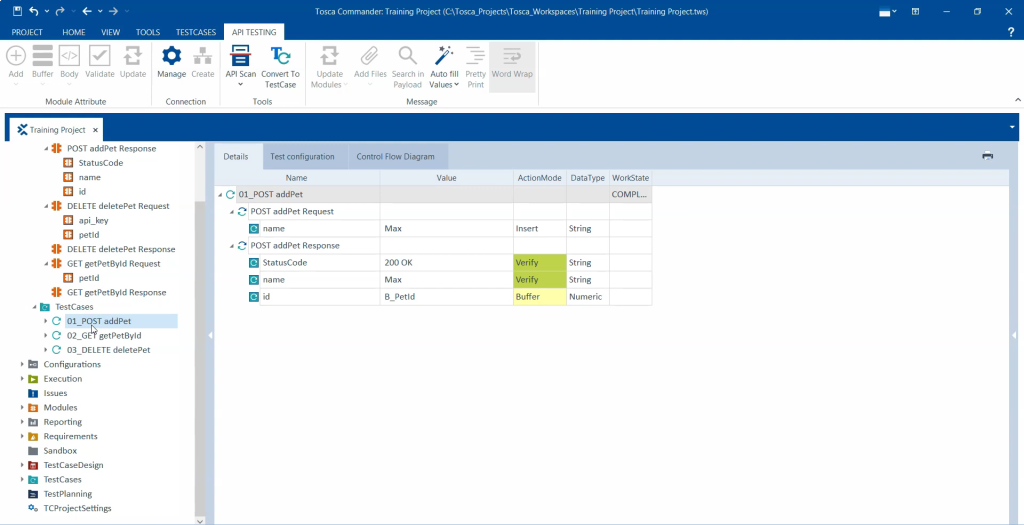
Tosca handles this through buffering. At runtime, a value returned in one API response such as an authentication token or a generated record ID is captured into a named buffer and referenced in subsequent calls.
For example:
- Step 1 calls the authentication endpoint and stores the token: {B[AuthToken]}
- Step 2 calls a protected resource and injects the token into the Authorization header: Bearer {B[AuthToken]}
- Step 3 uses the resource ID returned by Step 2: {B[CustomerID]}
This makes tests self-contained, repeatable, and independent of manual data preparation.
Validation Beyond Status Codes
A 200 OK response means the server accepted the request. It does not mean the response contains the right data, that business rules were applied, or that the payload structure matches what downstream systems expect.
Tosca validates at multiple levels:
- HTTP status codes : confirming the correct code was returned (200, 201, 400, 401, 404, 500)
- Response headers : checking Content-Type, cache controls, and security headers
- JSON and XML schema compliance : verifying the response structure matches the expected schema
- Field-level values : asserting that specific fields contain correct data, such as order status, customer tier, or price calculation
- Nested objects and arrays : drilling into complex response structures to validate individual elements
- Business rule verification : confirming that applied logic (discounts, approval thresholds, routing rules) produced the expected outcome
In the Salesforce-SAP scenario above, this means checking not just that the SAP order was created, but that the line items, quantities, pricing, and customer classification carried over correctly from Salesforce.
Real-World Example: SAP FICO and Bank Integration
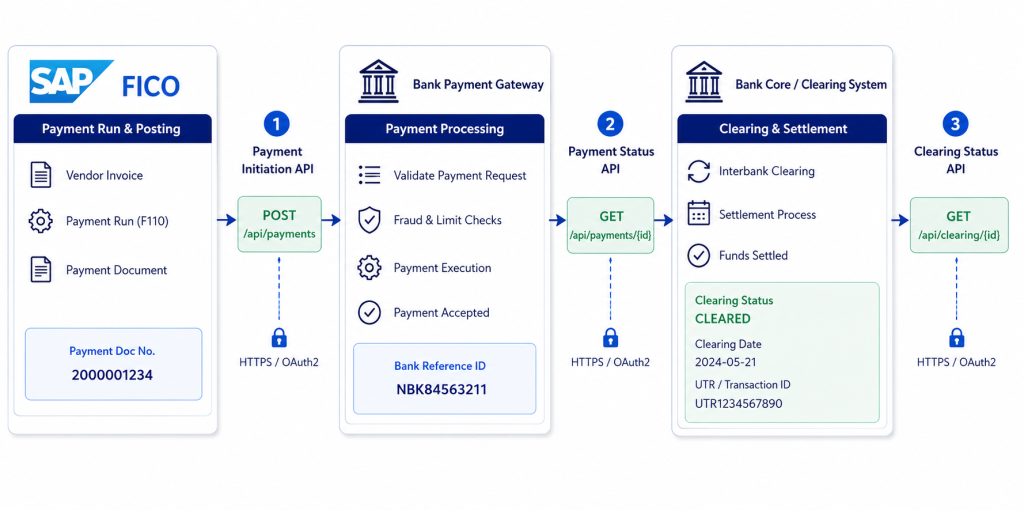
A common scenario in banking and corporate finance involves SAP Financial Accounting (FICO) posting a payment document and triggering a confirmation through a bank’s payment API. The test chain covers:
- POST to SAP FICO : Create a payment run and capture the document number
- POST to bank payment gateway API : Submit the payment details, capture the transaction reference
- GET payment status : Poll the bank API until the transaction reaches a confirmed or rejected state
- GET SAP FI document : Verify that the SAP document was updated with the correct clearing status
This kind of validation cannot be done through the SAP UI alone, and it cannot be done reliably with manual testing when payment windows are time-sensitive. Automating the chain in Tosca means this flow can be run as part of every regression cycle, not just before major releases.
Handling Unavailable Systems: (OSV)
Not every dependent system is available during every test cycle. Third-party payment gateways have sandbox limitations. Legacy systems may be under maintenance. External vendor APIs may enforce rate limits or require special access credentials that cannot be shared across test environments.
Tosca addresses this through Orchestrated Service Virtualization (OSV), which simulates the behavior of unavailable systems. A virtualized service responds to requests with pre-configured payloads that mirror what the real system would return, allowing testing to continue without delays or dependencies.
This is particularly useful in SAP integration testing, where connecting to a production SAP system for every test run is impractical. A virtualized SAP endpoint can return predictable responses that allow the connecting application to be tested thoroughly without touching the actual ERP.
Test Data Management
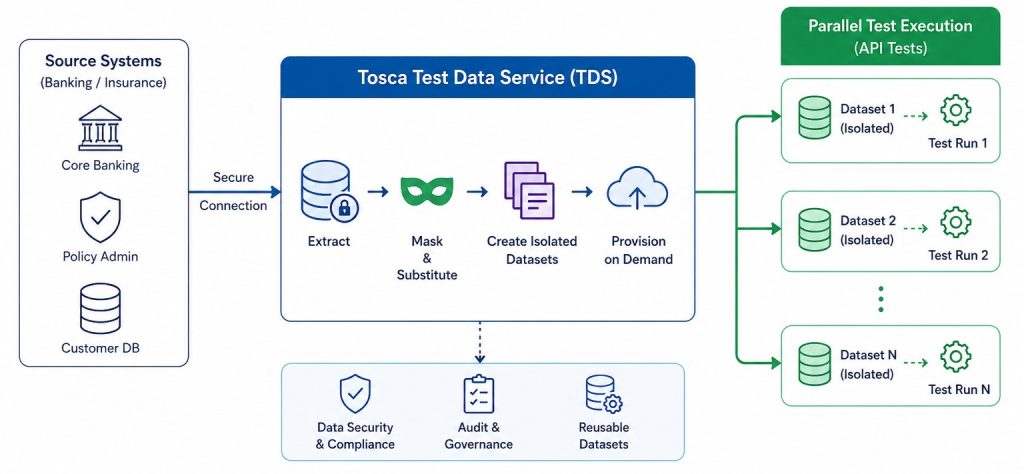
Enterprise testing requires clean, compliant, and conflict-free test data. This becomes especially complex in industries like banking, healthcare, and insurance, where test data must reflect realistic business scenarios while remaining compliant with GDPR, HIPAA, and PCI DSS.
Tosca’s Test Data Service (TDS) handles automated provisioning, data masking for sensitive fields, and centralized governance. It also supports parallel test execution without data conflicts different test runs use isolated datasets that do not interfere with each other.
In practice, this means a team testing a Salesforce-to-SAP order workflow can provision a clean set of customer and product records for each test cycle, masked appropriately, without manual data preparation before each run.
Security Testing Considerations
APIs are a primary attack surface in enterprise systems. Common vulnerabilities include missing or weak authentication, improper authorization (a user accessing resources they should not), exposed sensitive fields in responses, and insecure token handling.
Tosca’s API testing framework supports validation of authentication flows, authorization boundaries, and response payload hygiene. This includes verifying that:
- Requests without valid tokens return 401, not 200
- Requests with valid tokens for one user cannot access another user’s resources (authorization bypass checks)
- Sensitive fields such as card numbers, national IDs, or passwords are masked or absent from responses
- Token expiry is handled correctly and does not cause unhandled errors
These checks can be included in the same test suite as functional validation rather than treated as a separate security testing phase.
API Connection Manager: Centralizing Environment Configuration
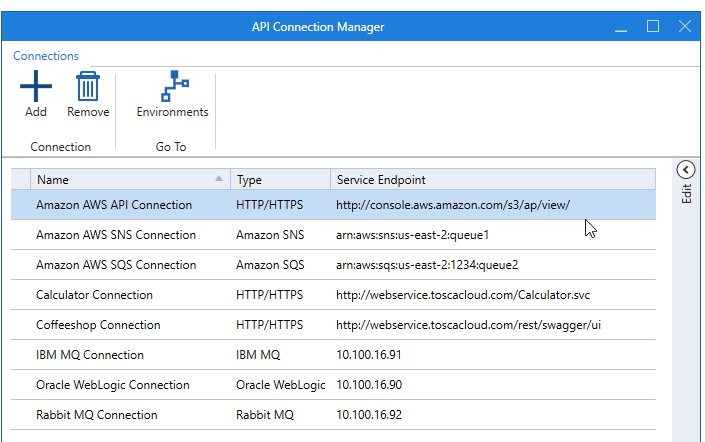
Enterprise teams typically test across multiple environments: development, QA, staging, and production. Each environment has different base URLs, authentication credentials, certificates, and sometimes different API versions.
Managing this manually leads to configuration drift tests that pass in QA because they are pointing at a slightly different endpoint, or failures in staging because a certificate was not updated.
Tosca’s API Connection Manager centralizes all environment-specific configuration. Switching a test suite from the QA environment to staging is a single configuration change, not a search-and-replace across dozens of test cases.
AI Capabilities in Current Tosca Releases
Tricentis has been adding AI-assisted features to Tosca incrementally. The most practical current capability is anomaly detection in response validation: the engine can flag unexpected field values, missing elements, or structural deviations in large response payloads without requiring testers to write exhaustive assertion rules for every field.
The roadmap points toward more autonomous behavior, including test case generation from natural language descriptions and self-healing tests that update themselves when API schemas change. These capabilities are in active development. Teams evaluating Tosca for AI-assisted testing should verify current feature availability with Tricentis directly, as the roadmap is evolving quickly.
Building a Maintainable Framework: Practical Recommendations
Based on how enterprise teams typically run into trouble with API test automation, the following practices make the most difference:
Scan first, script never: Use API Scan to generate modules from your OpenAPI or WSDL definitions. Avoid writing raw request configurations by hand these become maintenance debt immediately.
Separate test data from test logic: Use TDS or parameterized data sheets to keep test data out of test case configurations. Tests that hardcode values break when environments change.
Build chain tests for business processes, not just endpoints: An individual endpoint test tells you one API works. A chain test tells you a business process works. Prioritize the latter for your critical workflows.
Use OSV early: Do not wait until a dependent system is down to discover you cannot test. Set up virtual services for your most unreliable dependencies as part of initial framework setup.
Enforce image and naming hygiene from the start: This applies directly to Tosca workspace organization as well as to any documentation or reporting assets. Generic names and empty descriptions make maintenance harder as the suite scales.
Prioritize by business risk: A full regression suite covering every endpoint is not realistic for most teams. Focus coverage on the integrations that, if broken, directly affect revenue, compliance, or customer experience.
Conclusion
API testing is not a technical nicety. In an enterprise environment where dozens of systems exchange data continuously, it is the most direct way to validate that business processes work end to end.
Tricentis Tosca makes this tractable at scale through model-based automation, dynamic data handling, API chaining, and service virtualization. The Salesforce-to-SAP order workflow and the SAP FICO payment integration examples in this guide represent the kind of scenarios that break production systems when they are not tested properly and the kind of scenarios that Tosca is specifically built to cover.
For teams that have outgrown manual API testing or brittle scripted frameworks, Tosca offers a structured path to enterprise-grade automation without the overhead of maintaining large codebases.
Radixlink is a technology services firm specializing in test automation and quality engineering. For questions about implementing Tosca in your organization, contact the team at radixlink.com.
Tags: #API Testing, #Tricentis Tosca, #Enterprise Automation, #Salesforce Integration, #SAP Integration, #REST API, #SOAP API, #Test Automation, #Quality Assurance, #Service Virtualization, #Test Data Management