Introduction
Modern software applications depend heavily on APIs. They act as the communication bridge between systems, applications, and services, allowing data to move quickly and securely across platforms. Whether it is an online purchase, a banking transaction, a healthcare update, or an enterprise workflow, APIs are at the center of the process.
As organizations adopt microservices, cloud platforms, and digital transformation strategies, the number of APIs continues to grow rapidly. This growth brings flexibility and speed, but it also introduces new testing challenges. A single business process may involve multiple APIs interacting across different systems, environments, and technologies.
Traditional user interface testing alone cannot provide complete coverage in such environments. While UI testing verifies what users see and interact with, it does not fully validate backend logic, data flow, integrations, or security. UI tests are also slower, more fragile, and often expensive to maintain when applications change frequently.
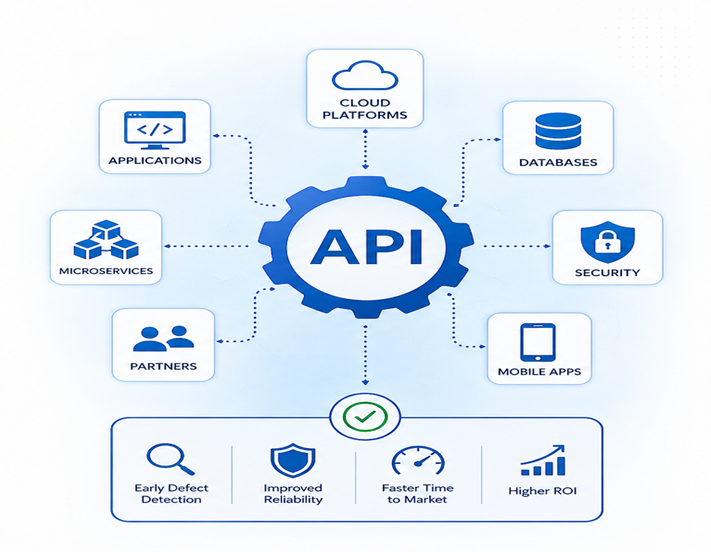
This is why API testing has become a critical part of modern quality assurance. By testing APIs directly, teams can identify defects earlier, improve reliability, and accelerate software delivery.
Tricentis Tosca addresses this need with a powerful model-based and low-code approach. It enables teams to create scalable, reusable, and easy-to-maintain automated tests, making enterprise-grade API testing faster, smarter, and more efficient.
Understanding API Testing in Tosca
API testing focuses on the backend services of an application rather than its graphical interface. Instead of checking buttons, forms, or screens, API testing validates how systems communicate, exchange data, and process business logic.
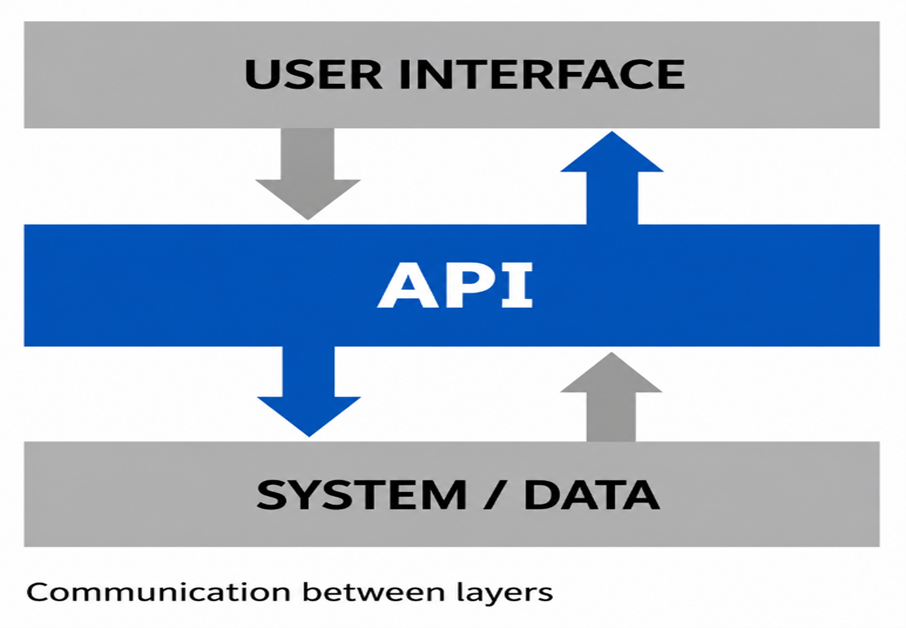
This form of testing ensures that APIs function correctly, securely, and reliably under different conditions. It verifies whether requests are accepted, responses are accurate, business rules are applied properly, and data is transferred without errors.
Core Components of Tosca API Testing
API Scan
API Scan is the starting point for API automation in Tosca. It reads service definitions from sources such as Swagger, OpenAPI, WSDL, and OData.
Instead of manually creating request structures or defining response schemas, testers simply scan the API. Tosca then automatically generates reusable modules that represent the API’s structure.
This automation saves time, reduces manual effort, and ensures consistency from the very beginning.
API Engine
Once the modules are created, the API Engine handles execution. It is responsible for:
- Sending API requests
- Receiving responses
- Processing payloads
- Validating results
- Supporting multiple protocols
- Managing runtime execution efficiently
The separation of design and execution improves both performance and flexibility.
Together, these components allow organizations to test services independently of the user interface. This supports earlier testing, faster feedback, and stronger software quality.
Why API Testing Is Essential in Modern Enterprises
In today’s connected business landscape, applications rarely work in isolation. They rely on APIs to exchange information with internal systems, third-party services, cloud platforms, and mobile applications.
A simple e-commerce order involves multiple services:
Login → Product → Cart → Payment → Order → Notification
If any single API fails, the entire flow breaks.
This is where most production issues originate — not from UI, but from service-to-service failures.
Key Benefits
- Early defect detection in development stages
- Faster feedback cycles
- Reduced production failures
- Improved system reliability
- Lower maintenance cost
- Stronger security validation
- Faster release cycles
This is why API testing is so important. It helps organizations ensure that each service works correctly both individually and as part of a larger business workflow. API testing is no longer optional—it is a business-critical necessity.
The Tosca Advantage: Model-Based Test Automation
One of the biggest reasons organizations choose Tricentis Tosca is its Model-Based Test Automation (MBT) approach.
Traditional automation frameworks require extensive scripting. Testers must manually write code for API requests, validations, authentication, payload structures, and error handling. This approach can be time-consuming, difficult to maintain, and highly dependent on technical expertise.
Whenever an API changes, multiple scripts may need to be updated. This increases maintenance effort and slows down delivery.
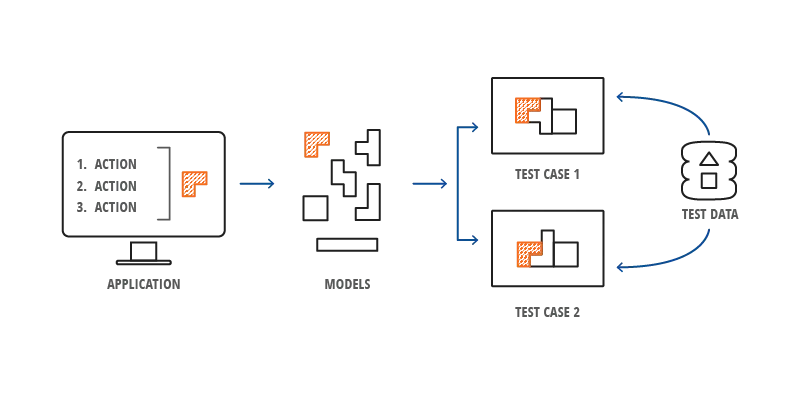
Tosca solves this problem by replacing scripts with reusable models. Instead of coding every test from scratch, testers scan the API once and create a reusable module. This module stores all technical details, including endpoints, request structures, headers, and response schemas.
Business logic and test data remain separate from technical implementation. As a result, when an API changes, the module can be updated in one place, and all related test cases are automatically aligned.
This approach delivers major advantages:
- Easier maintenance
- Higher reusability
- Faster test creation
- Reduced dependency on coding
- Better collaboration between technical and business teams
- Improved scalability across enterprise projects
In short, Tosca allows teams to focus on testing business outcomes rather than managing scripts.
Enterprise Protocol Support
Modern enterprises use a mix of technologies, and Tosca supports them all:
- REST APIs – Modern cloud and web services
- SOAP APIs – Legacy enterprise systems
- OData Services – SAP and Microsoft ecosystems
- GraphQL / Custom APIs – Flexible integration scenarios
This ensures unified testing across hybrid enterprise environments.
API Connection Manager
Managing environments manually is complex in large systems. Tosca simplifies this using centralized configuration.
It manages:
- Authentication tokens
- Environment URLs
- Headers
- Certificates
- Access credentials
This reduces duplication and ensures consistency across environments.
How API Testing Works in Tosca
The API testing process in Tosca follows a structured and user-friendly workflow.
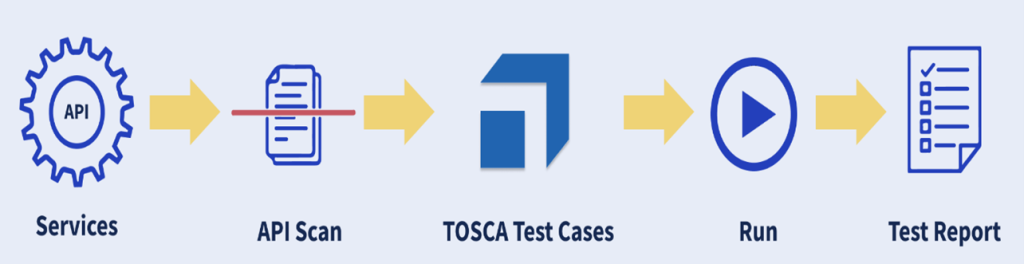
Step 1: Scan the API
The tester imports the API definition from Swagger/OpenAPI, WSDL, or OData sources. Tosca then generates reusable modules automatically.
Step 2: Verify Connectivity
Before creating test cases, testers can quickly validate:
- Endpoint accessibility
- Authentication setup
- Request structure
- Basic response behavior
This early verification helps identify configuration issues immediately.
Step 3: Design Test Cases
Using Tosca Commander, testers create test cases through a visual drag-and-drop interface. No coding is required.
Inputs, validations, and expected outcomes are configured using reusable modules.
Step 4: Execute and Validate
During execution, Tosca validates multiple aspects of the API, including:
- HTTP status codes
- Response headers
- JSON and XML schema compliance
- Field-level values
- Nested object structures
- Business rules and logic
This ensures complete validation of API behavior.
Deep Validation Capabilities
A successful API response is not just about receiving a 200 status code. True validation requires checking data accuracy, structure, and business correctness.
Tosca supports comprehensive validation at multiple levels.
Common Status Codes Validated
- 200 OK – Request completed successfully.
- 201 Created – A new resource was created.
- 400 Bad Request – Invalid input or request format.
- 401 Unauthorized – Authentication failed or is missing.
- 404 Not Found – Resource or endpoint not available.
- 500 Internal Server Error – Backend processing failed.
This deep validation improves end-to-end correctness, not just surface-level success.
Dynamic Data Handling in Real-World Scenarios
Real-world APIs rarely use static data. Values such as tokens, session IDs, customer IDs, timestamps, and transaction references change constantly.
Tosca handles this using buffering and parameterization. Example: {B[AuthToken]}
This allows:
- Runtime data reuse
- Realistic test execution
- Reduced manual intervention
Stable automation flows
Dynamic data handling makes automated tests more reliable and closer to real user interactions.
API Chaining: Testing End-to-End Business Workflows
In enterprise systems, APIs rarely operate independently. Most business processes involve multiple APIs working together in sequence.
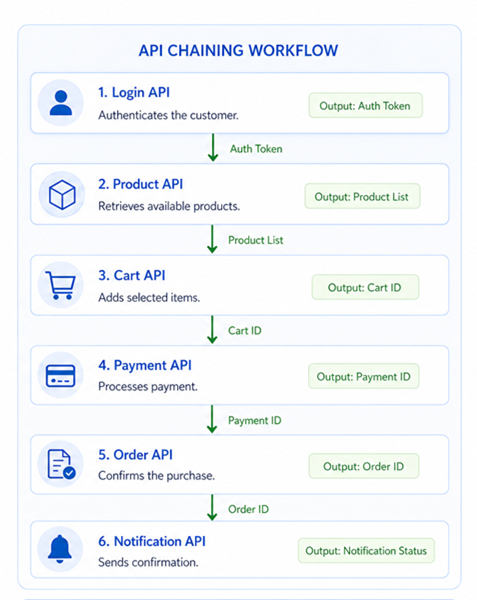
Tosca supports API chaining, where the output of one API becomes the input for the next.
Example: E-Commerce Journey
This approach validates the complete customer journey, ensuring all integrated services work together seamlessly.
Enterprise Use Case: Salesforce and SAP Integration
A common enterprise workflow involves integrating CRM and ERP systems.
For example, a business may create a customer order in Salesforce, process it through middleware, and complete fulfillment in SAP.
Typical Workflow
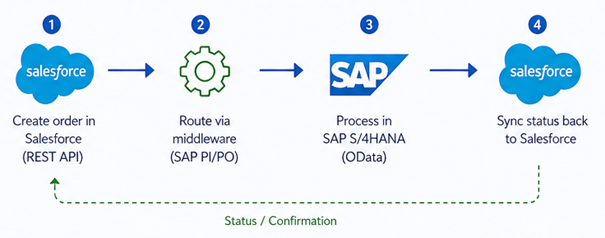
This end-to-end validation ensures business continuity across critical enterprise systems.
Security and Compliance Through API Testing
Security is one of the most important aspects of API quality.
Poorly secured APIs can expose sensitive business and customer data. They can also become entry points for cyberattacks.
Tosca helps identify critical security issues such as:
- Weak authentication
- Missing authorization
- Exposed sensitive data
- Insecure endpoints
- Improper token handling
It also supports compliance with:
- GDPR
- HIPAA
- PCI DSS
This ensures both security and regulatory alignment.
Advanced Enterprise Capabilities
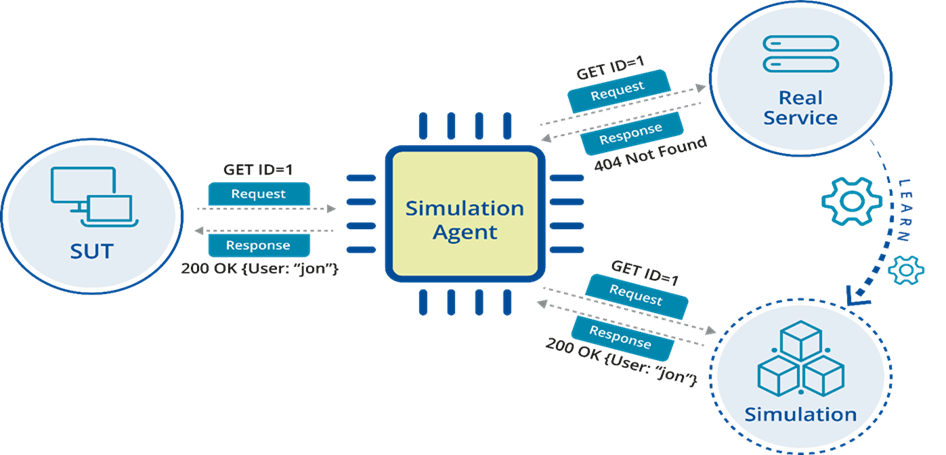
Orchestrated Service Virtualization (OSV)
In many testing environments, some dependent systems may be unavailable, costly, or difficult to access.
OSV solves this problem by simulating those systems.
- Third-party payment gateways
- External vendor services
- Legacy systems under maintenance
- Rate-limited APIs
- Unavailable external environments
This allows testing to continue without delays.
Test Data Service (TDS)
High-quality test data is essential for reliable testing. TDS provides:
- Automated test data provisioning
- Data masking for privacy protection
- Centralized data governance
- Conflict-free parallel execution
- Support for compliance requirements
This is especially valuable in industries such as banking, healthcare, and insurance.
AI-Driven API Testing in Tosca
Artificial intelligence is changing software testing, and Tricentis Tosca uses it to make testing faster and more accurate. Current AI features help teams find problems quickly by checking responses, spotting missing fields or strange values, and finding errors in large amounts of data. This reduces manual work while making tests more reliable.
Looking ahead, Tosca is moving toward autonomous quality engineering through Agentic Test Automation. This shift enables AI to perform tasks that traditionally required significant manual intervention, such as:
- Natural Language Processing: Generating complex test cases directly from plain-language prompts.
- Self-Healing Capabilities: Automatically updating and repairing tests after application changes to ensure continuity.
- Risk-Based Optimization: Using AI to optimize regression coverage based on business risk.
- Intelligent Execution: Executing tests automatically and providing deep, actionable insights into detected defects.
This future is further enabled by the Model Context Protocol (MCP), which provides a standardized framework for seamless communication between advanced AI systems and the Tosca environment.
Best Practices for Success: Navigating Enterprise API Challenges
Traditional API testing often struggles with brittle scripts, frequently expiring tokens, and unavailable backend systems. To overcome these hurdles and build a scalable framework, follow this integrated strategy using Tricentis Tosca:
- Eliminate Manual Scripting: Use API Scan to generate reusable modules automatically. Reusing these models ensures that when an API changes, you update once and all test cases align.
- Manage Dynamic Data: Handle shifting session IDs and authentication tokens via dynamic buffering (e.g., {B[AuthToken]}) to keep tests running without manual intervention.
- Virtualize the Unavailable: Use Orchestrated Service Virtualization (OSV) to simulate third-party gateways or legacy systems that are costly or difficult to access.
- Centralize Configurations: Use the API Connection Manager to manage environment-specific URLs and security certificates in one place, ensuring consistency across Dev, Test, and Prod.
- Structure for Scale: Organize workspaces with clear folder structures and consistent naming conventions to facilitate collaboration between technical and business teams.
- Focus on Risk: Prioritize testing based on business risks rather than quantity to achieve higher release confidence with a smaller, more effective test suite.
By combining Tosca’s model-based capabilities with these disciplined practices, organizations can reduce maintenance effort and significantly accelerate their software delivery cycles.
Conclusion
API testing has become a foundation of modern software quality. As organizations continue to embrace microservices, cloud-native architectures, and connected digital ecosystems, reliable API validation is more important than ever.
Tricentis Tosca provides a comprehensive solution for enterprise-scale API automation. Its model-based framework simplifies test creation, reduces maintenance, and improves collaboration. Features such as dynamic data handling, API chaining, service virtualization, and AI-driven validation make it especially powerful for complex enterprise environments.
By enabling faster testing, deeper coverage, stronger security, and greater scalability, Tosca helps organizations deliver high-quality software with confidence.
For teams looking to improve speed, reliability, and business value, mastering API testing in Tricentis Tosca is not just a technical skill—it is a strategic advantage in the modern digital world.